Tank to Vessel (TTV): What It Is and What It Is Not
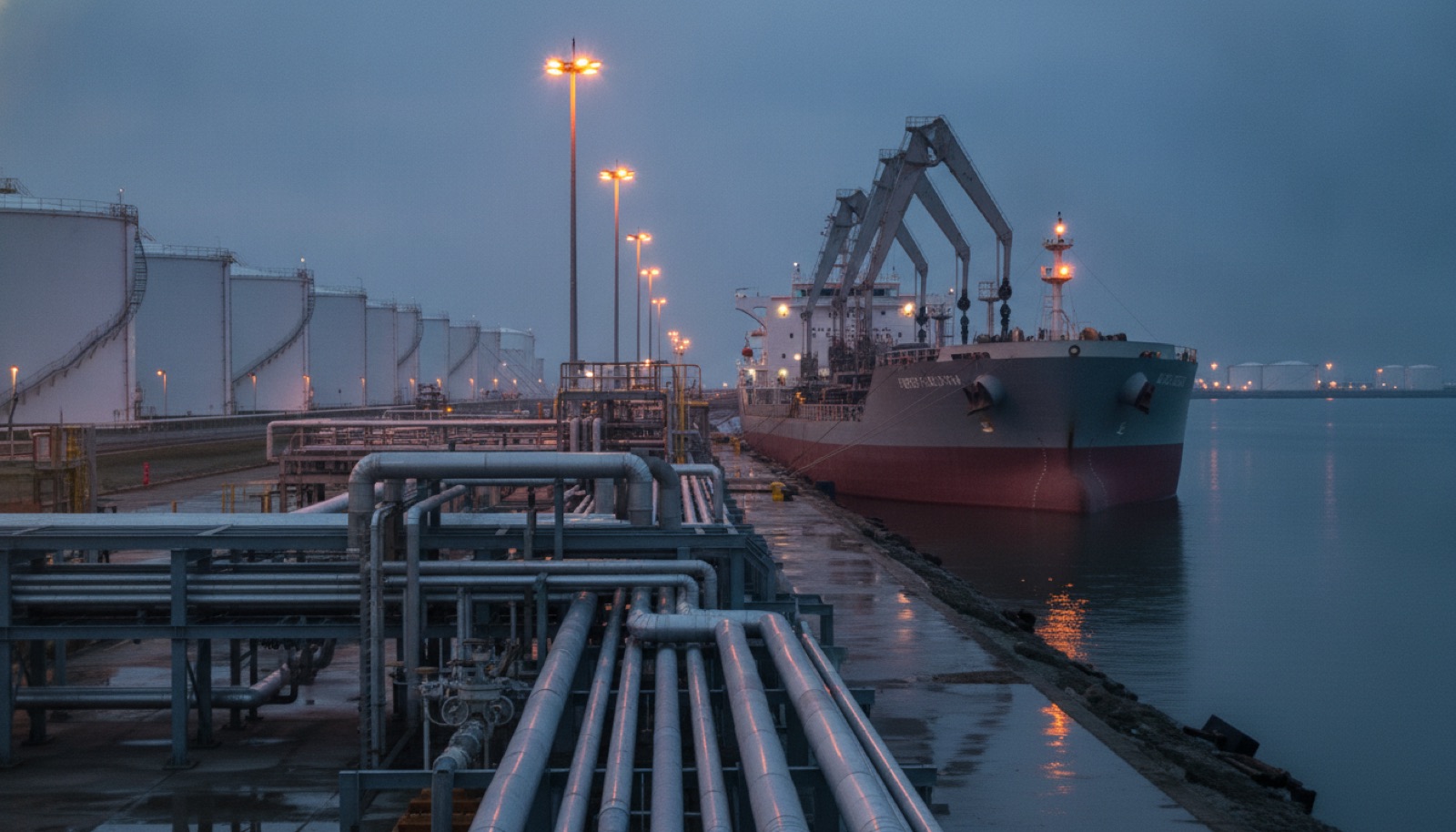
Tank to Vessel (TTV) is an operation, not a trade term: product already sitting in a shore tank at a storage terminal is pumped through the terminal''s lines and loading arms into a vessel you have nominated. Terminals do this every day and there is nothing exotic about it. What causes trouble is the procedure written around the acronym in unsolicited offers, which reads like a contract, allocates nothing, and usually asks the buyer to charter a ship before anything about the product has been verified. TTV is not an Incoterm. It says how the oil moves, not who carries which risk.
🎯 Key Takeaways
- TTV describes a physical transfer, shore tank to ship, measured and documented at the terminal.
- It is not an Incoterm and carries no allocation of cost, risk or delivery point. Your contract still needs one.
- "Dip and pay" is not the protection it sounds like: a dip proves liquid is in a tank, not that the seller owns it or that it is free of other claims.
- The vessel is the buyer''s exposure. Nominating and sailing a ship before the product is verified means freight and demurrage are spent on an unproven cargo.
- Verify the tank with the terminal directly, using contact details you found yourself, never the ones in the offer.
- Appoint your own inspector. A surveyor engaged and paid by the seller is not independent evidence.
Table of Contents
- What TTV Actually Means
- How the Transfer Actually Works
- The Documents It Produces
- Why TTV Is Not an Incoterm
- TTV, TTT, TTO and the Rest of the Family
- The Trouble With "Dip and Pay"
- The Vessel Is Where the Money Goes First
- What to Verify, and With Whom
- Red Flags in a TTV Offer
- What the Contract Has to Say
- Frequently Asked Questions
What TTV Actually Means
Tank to Vessel means the seller''s product is already in storage at a terminal, and delivery happens by pumping it out of that shore tank and into a vessel the buyer has nominated. It is most often quoted on refined products — gasoil and diesel, jet fuel, fuel oil, naphtha, base oils — and occasionally on bitumen and vegetable oils, anything that moves as a liquid through a terminal''s lines.
The appeal is obvious. The cargo supposedly exists already, in a named tank, at a named terminal. Nobody is waiting on a refinery allocation or a production run. A buyer can, in principle, send a surveyor to look at it before committing.
That last word is doing a great deal of work. In principle.
How the Transfer Actually Works
Stripped of the paperwork, the operation is short:
- The vessel arrives, berths at the terminal jetty and tenders Notice of Readiness.
- Ship and shore hold a pre-transfer conference and complete the ship/shore safety checklist. Hoses or marine loading arms are connected to the vessel''s manifold.
- The shore tank is gauged before loading — a physical dip or an automatic tank gauge reading — and samples are drawn.
- Product is pumped. Quantity is established either by shore tank gauging, opening figure against closing figure, or by calibrated terminal flow meters. Which one governs must be agreed in advance, because they will not agree exactly.
- The vessel''s own tanks are gauged on completion. Ship figures and shore figures are compared, and the difference is recorded as the vessel experience factor.
- Samples are sealed. Documents are issued. The vessel sails.
None of this is unusual or suspicious. It is the ordinary business of every products terminal in Rotterdam, Houston, Fujairah, Singapore and everywhere else. The question is never whether a terminal can do a TTV. It is whether the specific parcel, in the specific tank, belongs to the person offering it.
The Documents It Produces
| Document | Issued by | What it evidences |
|---|---|---|
| Tank storage receipt | Terminal | Product is held for a named party |
| Tank Storage Agreement | Terminal and holder | The holder actually has capacity there |
| Ullage / dip report | Terminal or surveyor | Volume in the tank at a moment in time |
| Certificate of Quality | Independent lab | The product meets specification |
| Certificate of Quantity | Independent surveyor | How much was actually transferred |
| Bill of lading | Master / agent | Cargo is on board; title document |
| Statement of Facts | Agent | Timeline, for demurrage claims |
Note which of these is the title document. It is the bill of lading, issued after the product is on your ship. Everything above it in the table is evidence about a tank, and evidence about a tank is not ownership of what is in it.
Why TTV Is Not an Incoterm
The Incoterms rules are eleven defined terms published by the ICC. Each one fixes the delivery point, the moment risk passes, who contracts carriage, who insures, who clears export and import, and who pays which cost. TTV does none of that. It is a description of an operation, in the same way that "by conveyor" describes how coal reaches a ship.
This matters in a specific and expensive way. An offer that says "TTV Rotterdam" has told you where the oil is and how it will move. It has not told you when risk passes to you, who pays the terminal''s throughput fee, who bears the loss if the pumped quantity is short, or what happens if the product fails specification after loading. Those are exactly the questions that turn into disputes, and the acronym is silent on all of them.
TTV, TTT, TTO and the Rest of the Family
The same offer circuits use a small vocabulary of related acronyms. They are worth separating, because they carry very different amounts of risk.
| Term | What happens | Buyer needs |
|---|---|---|
| TTV — tank to vessel | Shore tank pumped into your ship | A chartered vessel and a berth |
| TTT — tank to tank | Product moves to your tank at the same terminal | Your own storage agreement |
| TTO — tank takeover | You take over the tank itself, product inside | Terminal to accept you as holder |
| CIF / FOB | Defined Incoterms delivery | A contract that names the rule |
TTT and TTO both require the terminal to accept you as a customer in your own right, which means the terminal knows who you are and has run its own checks on you. That is a meaningful hurdle, and it is one reason offers gravitate toward TTV instead: it asks the buyer to bring a ship rather than a relationship.
The Trouble With "Dip and Pay"
The phrase appears in almost every TTV procedure. The buyer sends a surveyor, the tank is dipped, the buyer sees the product with their own eyes and pays. It sounds like the safest possible arrangement, and it is the single most misunderstood step in this trade.
A dip establishes one fact: at that moment, that tank contained that volume of a liquid that sampled to that specification. It says nothing whatsoever about:
- Who owns it. Tanks hold product for whoever has the storage agreement. The dip does not show whose name that is.
- Whether it is already sold. The same parcel can be, and has been, shown to several buyers in the same week.
- Whether it is pledged. Financed cargo is routinely held to a bank''s order. It is in the tank and it is not available.
- Whether it will still be there. Product can be moved out of a tank between the dip and the vessel''s arrival.
- Whether that tank is the one you get. A dip on tank 14 says nothing about what is pumped through the line on loading day.
Paying against a dip converts your money into a claim against the seller. Paying against a bill of lading converts it into a claim on cargo that is on your own ship. Those are not the same position, and the gap between them is where losses in this market live.
The Vessel Is Where the Money Goes First
The step in a TTV procedure that quietly costs the most is not the payment. It is the nomination.
To load, the buyer must charter a vessel, nominate it to the terminal, and have it arrive within an agreed laycan. A products tanker on a short voyage is a serious commitment, and once it has tendered Notice of Readiness the clock runs. If the product is not there, is not free, or fails the terminal''s own checks, the buyer owns the consequences: demurrage on a ship waiting at a berth for cargo that never comes.
This is why the ordering of a procedure matters more than its contents. Any sequence that puts vessel nomination before verified, terminal-confirmed proof of product has moved the first real cost onto the buyer while the seller has spent nothing. Read the steps in that light and a lot of otherwise plausible procedures look different.
What to Verify, and With Whom
- Confirm the tank with the terminal yourself. Find the terminal''s published contact details independently. Never use a phone number, email address or contact name supplied in the offer, and treat a terminal email on a free or lookalike domain as no confirmation at all.
- Ask the terminal the right question. Not "is there product in tank 14" but whether the named seller holds a current storage agreement, whether the product is free and unencumbered, and whether the terminal will act on that party''s instructions.
- Appoint your own inspector. SGS, Intertek, Bureau Veritas, Saybolt, Camin Cargo — engaged and paid by you. A report addressed to the seller is the seller''s evidence, not yours. See what an inspection report does and does not cover.
- Check the seller, not just the cargo. A verified tank in the hands of an unverified company is still an unverified trade. KYB comes before the dip, not after it.
- Treat proof of product as a starting point. Tank receipts, authorisations to board and inject, and dip reports are all documents that can be produced on a laptop. Their value is what the issuer confirms when you contact the issuer.
- Settle the measurement basis before loading. Shore figures or ship figures, which surveyor''s certificate governs, and what tolerance applies.
Red Flags in a TTV Offer
- A rigid, numbered "procedure" you must accept as-is. Real terminal business is negotiated; a fixed ten-step sequence that cannot be altered exists to move you through it.
- Vessel nomination or charter demanded before verified proof of product. The costly step first.
- A non-refundable fee for the dip test, or any payment before loading that is not held against the cargo.
- Terminal contact details supplied by the seller, particularly a named person who will "expect your call".
- Refusal to accept your surveyor, or insistence on one particular company.
- Large volumes at a steep discount to the published market, arriving unsolicited.
- Payment demanded by telegraphic transfer against a dip rather than against shipping documents or under a letter of credit. See the guide to the types of letter of credit for what protection each one actually gives.
- A chain of intermediaries between you and whoever supposedly holds the storage agreement.
The document-side version of the same pattern is covered in MT-103 Fraud: How Fake Proof of Funds Destroyed $40M in Deals, and the paperwork that usually precedes a TTV procedure is unpicked in ICPO vs LOI in Commodity Trading.
What the Contract Has to Say
A TTV deal that is going to survive contact with a terminal needs all of this written down, because none of it is implied by the acronym:
- The Incoterms rule and version, and the named delivery point.
- The terminal, the tank, and the seller''s capacity there.
- Which measurement governs quantity, and the permitted tolerance.
- Who appoints and pays the independent surveyor, and whether the certificate is final and binding.
- The specification, the test methods, and what happens on off-spec product.
- Laycan, the berth, and demurrage rate and terms.
- Terminal throughput, storage and any heating costs, and who carries them.
- The payment trigger, named precisely: against bill of lading, against the surveyor''s certificate, or under a documentary credit.
- What happens if the product is not free on the nominated date, including who pays the waiting vessel.
Where Lodfy fits
No procedure protects you from a counterparty who should never have been on the other side of the table. Companies on Lodfy are KYB-verified — registration, ownership and sanctions screening — before they can transact, so the entity offering a tank is one whose existence has already been established. The contract, the parties and the documents then live against that verified company rather than against an email address and a PDF.
Frequently Asked Questions
What does TTV stand for in oil trading?
Tank to Vessel. Product held in a shore tank at a storage terminal is pumped through the terminal''s lines into a vessel nominated by the buyer.
Is TTV an Incoterm?
No. The Incoterms rules are eleven defined terms published by the ICC, and TTV is not among them. It describes a physical operation and allocates no cost, risk or obligation. A TTV sale still needs an Incoterm, usually FOB at the loading terminal.
What is the difference between TTV and TTT?
TTV moves product from a shore tank onto a ship. TTT moves it from the seller''s tank into the buyer''s tank, usually at the same terminal, which means the buyer needs their own storage agreement rather than a vessel.
Is "dip and pay" safe?
Less than it sounds. A dip proves a volume of product of a given specification was in a tank at that moment. It does not prove the seller owns it, that it is unsold, that it is not pledged to a bank, or that it will still be there when your vessel arrives.
Who pays for the inspection under TTV?
It is negotiable and should be stated in the contract, but the buyer should appoint and pay their own inspector regardless of what the seller offers. An inspection commissioned by the seller is the seller''s evidence.
What is an ATB or ATV in a TTV procedure?
Authority to board and authority to verify: documents that supposedly let the buyer''s surveyor enter the terminal and inspect the tank. They are terminal-issued in principle and easy to forge in practice, so their worth is whatever the terminal confirms when you contact the terminal directly.
Should I nominate a vessel before the product is verified?
No. Chartering and nominating is the first substantial cost in the deal, and once the ship tenders Notice of Readiness the demurrage clock runs. Verification belongs before nomination, not after it.