Chicken Feet vs Chicken Paws: What Buyers Order
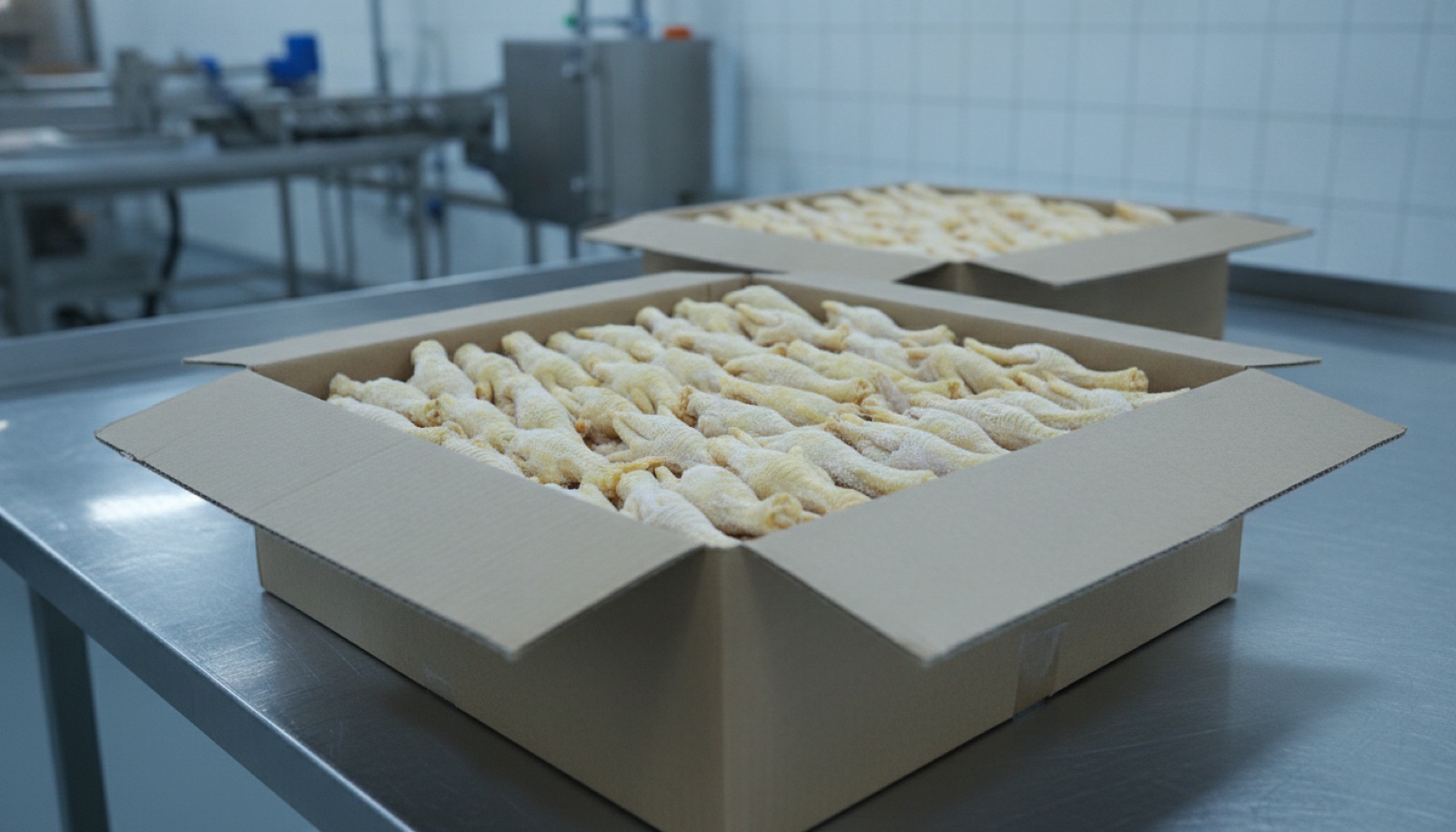
Chicken paws and chicken feet are often quoted as if they were the same product, and they trade at different prices because they are not. In North American export practice, paws means the foot alone, cut at the hock joint, with no shank attached — the format that dominates shipments to China and Hong Kong. Feet is used more loosely and, depending on origin, may include part of the lower leg. The words are not standardised across markets, so a purchase order that says only "chicken feet, Grade A" has not yet described what will arrive.
🎯 Key Takeaways
- The terms are not interchangeable in practice even though they are used interchangeably in enquiries.
- The cut point is the specification: at the hock, above it, or below it changes the yield, the piece weight and the price.
- Grade A is about defects, not size: intact skin, no fractures, no bruising, correct colour — always define it, never assume it.
- Piece count per kilogram is the number that settles arguments more reliably than any adjective.
- Format matters as much as the cut: most premium business is IQF; block is the processing and lower-grade route.
Table of Contents
- Why the Terminology Is Confusing
- What "Paws" Means in Trade
- What "Feet" Means in Trade
- Paws vs Feet: Side by Side
- Grading, Defects and What Grade A Should Mean
- The Specification That Prevents Disputes
- Where the Demand Is
- Common Ways These Deals Go Wrong
- Frequently Asked Questions
Why the Terminology Is Confusing
Poultry by-product trade grew up across several regions at once, each with its own vocabulary, and no single body imposed a shared one. A processor in Arkansas, an importer in Guangzhou and a trader in São Paulo can all use the word "feet" and mean three different cuts. Customs classification does not resolve it either: frozen edible poultry offal generally sits under HS heading 0207.14, which is far broader than the distinction buyers actually care about.
The result is a market where the descriptive term is nearly useless on its own, and where the real specification is a handful of physical parameters. Traders who write those parameters down do not have these arguments. Traders who rely on the word do.
What "Paws" Means in Trade
"Paws" is the North American export term. It refers to the foot only: the product is severed at the hock joint, so the shank — the lower leg above the foot — is not included. This is the format built for the Chinese and Hong Kong markets, where paws are a culinary staple in their own right rather than a stock ingredient.
Because paws are a high-value export product rather than a rendering input, the commercial expectations are correspondingly strict. Skin should be intact and undamaged, because it is what the dish is made of. The colour should be clean and even. Fractured bones are a defect, not a cosmetic quibble, because they are unpleasant to eat around. Most premium paw business moves IQF, in poly bags inside cartons, so the buyer can portion by weight.
What "Feet" Means in Trade
"Feet" is the looser term. In some origins it is simply the local word for the same product paws describes. In others, it denotes a cut that includes part of the shank, which raises the weight per piece and changes what the buyer can do with it. Shank-on product suits stock, broth and collagen extraction, where the extra bone and connective tissue are the point; it suits dim sum service considerably less.
Brazilian and other South American exporters commonly market under "feet". That is not a lower standard — Brazil is a major, highly capable poultry exporter — but it is a reason to confirm the cut rather than assume it matches an American paw specification.
Paws vs Feet: Side by Side
| Factor | Paws | Feet |
|---|---|---|
| Usual meaning | Foot only, cut at the hock | Foot, sometimes with shank attached |
| Term used by | North American exporters | South American, European, Asian traders |
| Primary destination | China, Hong Kong, Vietnam | Asia and Africa, broader mix |
| Typical end use | Dim sum, braised dishes, retail packs | Stock, broth, collagen, food service |
| Appearance sensitivity | High — skin is the product | Moderate, depends on end use |
| Common format | Mostly IQF | IQF or block |
Treat this table as the pattern, not the rule. Individual exporters use their own house definitions, and several use the two words as exact synonyms. Confirm in writing before you price.
Grading, Defects and What Grade A Should Mean
"Grade A" appears in almost every enquiry and is defined in almost none of them. It is not a single international standard for this product; it is a shorthand that each supplier fills in differently. When a buyer and a seller each assume their own version, the gap shows up at the discharge port.
A workable Grade A definition names the defects that are excluded and the tolerance for each:
- Broken or fractured bones — the most frequent rejection reason on premium paw contracts.
- Skin damage: tears, scald marks, missing skin.
- Bruising and discolouration, with a stated acceptable colour range.
- Lesions, callouses and foot-pad damage, which reflect husbandry conditions.
- Nails — present or removed, which is a specification choice and not a defect either way.
- Foreign material and residual feathers.
Then add the parameter that ends most arguments before they start: piece weight range, or pieces per kilogram. Adjectives are arguable; a count is not. If a buyer expects roughly 25 pieces per kilogram and receives 40, the dispute is settled by weighing a sample, and no one needs to litigate the meaning of "large".
The Specification That Prevents Disputes
A purchase order that will not surprise anyone contains, at minimum:
- Cut: foot only cut at the hock, or shank-on — stated explicitly, whichever word appears in the title.
- Piece weight range or pieces per kilogram, with tolerance.
- Nails: on or off.
- Freezing format: IQF or block, and for block the unit weight.
- Glaze percentage and whether price is on net or gross weight.
- Defect tolerances written out, rather than the word "Grade A" alone.
- Packaging: inner bag weight, carton weight, palletisation and label language.
- Plant approval: the establishment number and its listing for the destination market.
- Health certification required at import, and who is responsible for obtaining it.
- Inspection: the surveyor, the point of inspection, and whether the certificate binds on quality, weight or both.
Related reading
The freezing format is half of this specification, and it drives price, thawing and the net-weight calculation. See IQF vs Block Frozen: What the Difference Costs You for how the two processes differ and what to write into the contract about glaze.
Where the Demand Is
Demand is concentrated in East and Southeast Asia, with China and Hong Kong the anchor markets and Vietnam a significant one. Consumption is culinary rather than industrial — these are dishes people order by name — which is why appearance and piece integrity carry a price premium that would look irrational for a rendering input.
The supply side is a by-product economy. Feet and paws have limited value in most Western domestic markets, so exporting them turns a low-value stream into a high-value one. That asymmetry is what makes the trade attractive, and it is also why market access is the fragile part: this product moves on bilateral veterinary agreements and approved-establishment lists, and those change with animal-health events and trade policy. A plant approved for a destination last quarter may not be this quarter.
Verify establishment approval for the specific destination before you contract, not after the container is loaded. It is the single most expensive thing to discover late in this trade.
Common Ways These Deals Go Wrong
- Ordering by word, not by cut. "Chicken feet, Grade A, 27 MT" describes a quantity and almost nothing else.
- Assuming Grade A is standardised. It is a heading for a defect list, and the list is what you are actually buying.
- Leaving glaze undefined. Two identical-looking quotes can differ substantially in real product delivered.
- Missing the establishment listing. Correct product, correct paperwork, plant not approved for that destination — and the container does not clear.
- Ignoring shelf life at arrival. Long lanes consume months of it; specify what must remain at discharge, not at production.
- No named surveyor. Without an agreed arbiter, every parameter above becomes a negotiation after the fact.
Frequently Asked Questions
Are chicken paws and chicken feet the same thing?
Sometimes, and that is the problem. In North American export practice, paws means the foot alone cut at the hock; "feet" is used more broadly and may include part of the shank. Many suppliers use the words as synonyms. Confirm the cut in writing rather than relying on the term.
Which is more expensive?
It depends on the cut and the grade, not the word. Clean, unbroken, appearance-grade product for the Chinese retail and restaurant trade commands the premium. Shank-on product sold for stock or collagen extraction generally sits lower, because appearance matters less and the buyer is paying for mass and connective tissue.
Should I buy IQF or block?
IQF for anything sold on by the piece or by retail pack, block for product going into a single industrial process. Most premium paw business is IQF. See the IQF versus block frozen guide for the full comparison.
What HS code applies?
Frozen edible poultry offal generally falls under HS heading 0207.14, with national subheadings varying by country. Always confirm the exact subheading with your customs broker for the specific origin and destination — the classification affects duty and, in some markets, the licence required.
What is the single most useful line to add to a paws specification?
Pieces per kilogram, with a tolerance. It is objective, it is testable with a scale at any point in the chain, and it resolves the size disputes that adjectives like "large" or "premium" are guaranteed to create.