IQF vs Block Frozen: What the Difference Costs
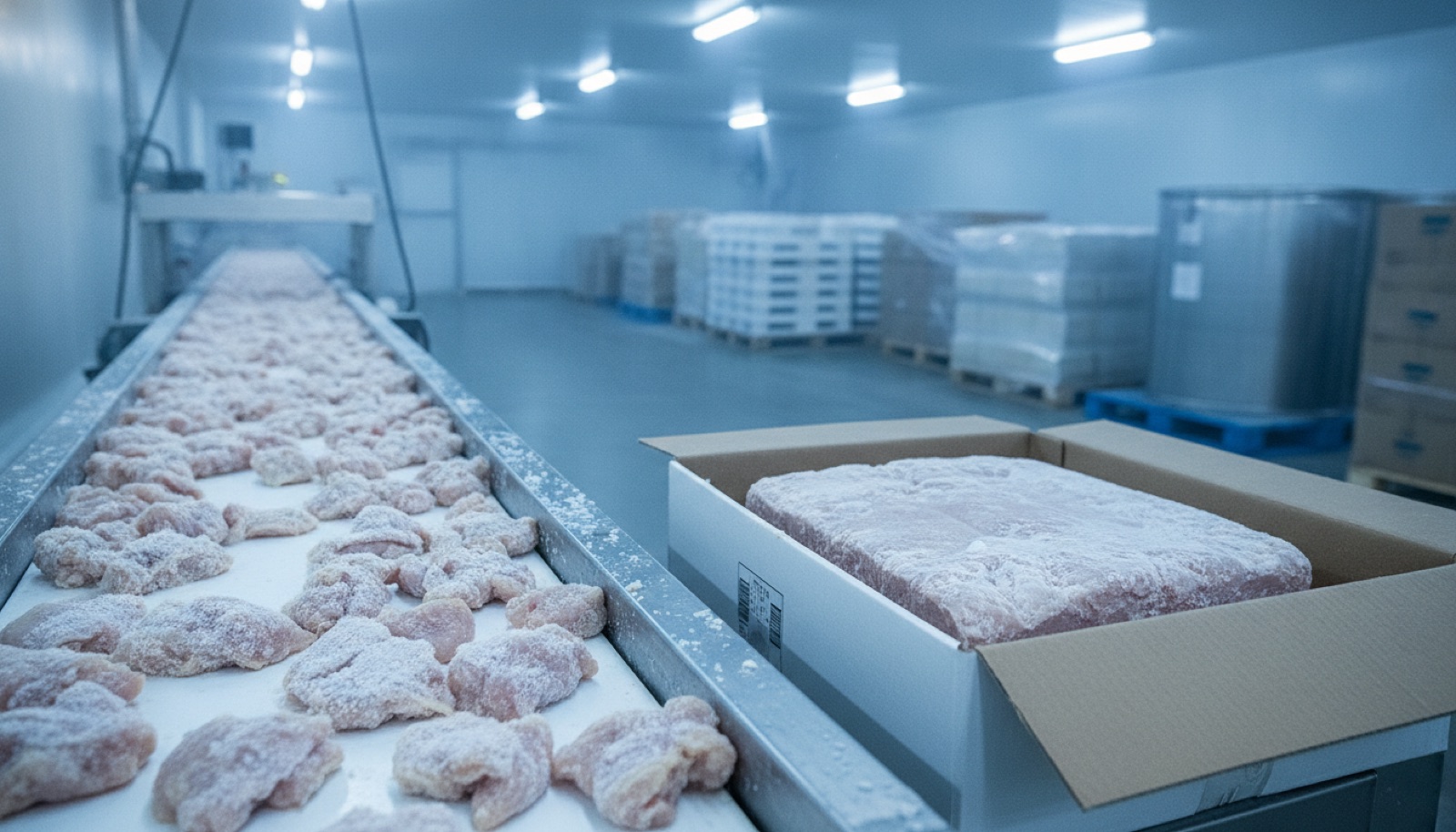
IQF (Individually Quick Frozen) and block frozen describe how poultry, seafood and produce are frozen — not how good they are. IQF freezes each piece separately in minutes, so the product pours loose from the bag and the buyer portions freely. Block freezing sets the product as one solid mass, usually in a 10 kg or 15 kg carton, and is cheaper per tonne but must be thawed whole. The choice drives your price, your packaging, your cold-chain tolerance and — most often disputed — how net weight is calculated once glaze is stripped out.
🎯 Key Takeaways
- IQF is a process, not a grade: it says pieces were frozen individually and fast, nothing about the quality of the raw material.
- Block is cheaper to produce and ship: fewer packaging steps, denser pallets, lower freezing cost per tonne.
- Thawing decides the buyer: processors who will cook the whole carton favour block; anyone portioning by piece needs IQF.
- Glaze belongs in the contract: state glaze percentage and whether the price is on net or gross weight, or you are negotiating it at the discharge port.
- Cold chain is stricter for IQF: a partial thaw fuses loose pieces into a block, and the buyer will call that a downgrade.
Table of Contents
- What IQF Actually Means
- What Block Frozen Means
- IQF vs Block Frozen: Side by Side
- Ice Crystals, Drip Loss and Why Speed Matters
- Glaze, Net Weight and the Argument at Discharge
- Which One Should You Buy?
- Writing It Into the Contract
- What to Check on Inspection
- Frequently Asked Questions
What IQF Actually Means
IQF stands for Individually Quick Frozen. Each piece — a chicken paw, a prawn, a raspberry — passes through a freezer on a belt or in a fluidised bed of cold air and reaches its frozen core temperature in minutes rather than hours. Because the pieces are separated while freezing, they never bond to each other. The finished product pours loose out of the bag.
Two things follow from that, and both matter commercially. First, the buyer can take out two kilos and leave the rest frozen, which is the whole point for retail packers and food service. Second, the freezing itself is fast enough to change what happens inside the cells, which is the quality argument covered further down.
It is worth being precise about one thing: IQF is a description of the process, not a grade. An IQF label tells you the pieces were frozen individually and quickly. It tells you nothing about the age of the bird, the state of the skin, the bacterial load or whether the pieces are broken. Those need their own lines in the specification.
What Block Frozen Means
Block frozen product is packed into a carton, pan or mould and frozen as a single mass. The commonest formats in poultry and seafood trade are 10 kg and 15 kg blocks, often two or three to a master carton. The block takes hours rather than minutes to freeze through, because the centre is insulated by everything around it.
The economics are straightforward. There is less handling, less packaging material, no need for a spiral or fluidised-bed freezer, and the blocks stack densely so a container carries more saleable weight and less air. For a processor who is going to tip the whole block into a cooker, a brine tank or a mincer, none of the disadvantages apply — and the price per tonne is lower.
IQF vs Block Frozen: Side by Side
| Factor | IQF | Block frozen |
|---|---|---|
| Freezing time | Minutes per piece | Hours to the core |
| Ice crystals | Small, numerous | Larger, especially at the centre |
| Portioning | Any quantity, pieces stay loose | Whole block must be thawed |
| Typical pack | 1–10 kg poly bags in cartons | 10 kg / 15 kg blocks |
| Cost per tonne | Higher — equipment, packaging, handling | Lower |
| Container utilisation | More void space between pieces | Denser, less air per tonne |
| Cold-chain tolerance | Low — a partial thaw clumps the pieces | Higher — already one mass |
| Best suited to | Retail packing, food service, re-export in small lots | Further processing, cooking, mincing, rendering |
Ice Crystals, Drip Loss and Why Speed Matters
When water freezes slowly, it forms fewer and larger ice crystals. Inside meat, those crystals grow large enough to rupture cell walls. On thawing, the cells cannot hold their water and it runs out — this is drip loss, and it takes soluble protein and flavour with it. Fast freezing produces many small crystals instead, which do less structural damage.
That is the quality case for IQF, and it is real. But it is regularly overstated in sales material, so keep two qualifications in mind:
- The raw material still dominates. A fast freeze cannot improve a bird that was poorly chilled, roughly handled or held too long before processing. It only preserves the condition the product was already in.
- Storage matters as much as freezing. Temperature fluctuation in a cold store causes recrystallisation — small crystals migrate and grow — which erodes the advantage over months. A well-frozen product held badly ends up no better than a block.
If drip loss is commercially important to you, put a maximum on it in the specification and name the method used to measure it. "IQF" on a label is not a substitute for a number you can test against.
Glaze, Net Weight and the Argument at Discharge
Glazing is a thin layer of ice applied deliberately to the outside of frozen pieces to protect them from freezer burn and oxidation. It is legitimate and useful. It is also, in practice, the single most common source of disputes on frozen protein contracts — because glaze is water, water is weight, and weight is money.
The problem is almost never that glaze exists. It is that the contract did not say how much, or whether the price applied to net (deglazed) weight or gross weight including glaze. Two shipments quoted at the same headline price can differ by a substantial margin in real product delivered, entirely legally, if one carries far more glaze than the other.
Glaze applies to both formats, but it comes up far more often with IQF, simply because individually frozen pieces have vastly more surface area to hold ice than a solid block does.
Put four things in writing: the glaze percentage, the tolerance around it, whether the price is on net or gross weight, and the deglazing method that will be used if the parties test it. Without the fourth, you can agree on the first three and still argue.
Which One Should You Buy?
Work backwards from what happens to the product after it lands.
Choose IQF when the product will be sold on by the piece or the small pack, when the end buyer needs to take part of a carton and refreeze nothing, when appearance matters because the pieces will be visible at the point of sale, or when you are breaking a container into several smaller onward sales.
Choose block when the whole carton goes into a single process — cooking, marinating, mincing, rendering, pet food — when you are buying on price per tonne of usable protein, or when the destination cold chain is unreliable enough that clumping would be inevitable anyway.
A practical note on the third case: buyers sometimes specify IQF for prestige and then receive product that has partially thawed and refrozen into an irregular mass in transit. That is worse than block from the start, because it now fails its own specification and invites a claim. If the lane is genuinely marginal, block is the more honest choice.
Writing It Into the Contract
A frozen protein specification that avoids arguments usually names all of the following:
- Format: IQF or block, and for block the unit weight (10 kg / 15 kg) and the number per master carton.
- Glaze: percentage, tolerance, and net-or-gross pricing basis.
- Core temperature at loading and the maximum permitted on arrival.
- Piece specification: weight range per piece, and the allowance for broken or off-spec pieces.
- Packaging: inner bag material and weight, carton construction, palletisation, labelling and language.
- Shelf life remaining at the discharge port, not at production — the two are very different on a long lane.
- Inspection: who appoints the surveyor, at which point, and whether their certificate is final and binding on quality, weight, or both.
That last line is worth more than most of the others combined. A specification without an agreed arbiter is a list of things to disagree about.
What to Check on Inspection
- Do the pieces actually separate? Pour a bag out. Loose pieces are IQF. Clumps are a cold-chain failure or a mislabelled block.
- Freezer burn: dry, greyish or leathery patches mean the product has lost surface moisture, usually from inadequate glaze or long storage.
- Ice inside the bag: loose snow or a sheet of ice at the bottom points to a thaw-and-refreeze cycle somewhere in the chain.
- Deglazed weight on a sample, against the contractual basis.
- Core temperature taken with a probe, not read off the container's display.
- Carton condition and labelling against the destination market's import requirements, which are frequently the reason a container sits at a port.
Related reading
The IQF-versus-block decision comes up constantly in poultry by-products, where the terminology is its own minefield. See Chicken Feet vs Chicken Paws: What Buyers Are Actually Ordering for how the two terms differ, why the shank changes the price, and what belongs in the specification.
Frequently Asked Questions
Is IQF always better quality than block frozen?
No. IQF describes how the product was frozen, not how good it was beforehand. Fast freezing preserves texture better, but it cannot improve poor raw material, and the advantage erodes if the cold store temperature fluctuates. For product destined for cooking or mincing, the difference is often not worth the premium.
Why is IQF more expensive?
Three reasons: the freezing equipment is more capital-intensive, the packaging and handling steps are more numerous, and loose pieces leave void space in a container, so you ship less product per tonne of freight.
What glaze percentage is normal?
It varies widely by product, destination market and contract, and several markets regulate it. Rather than assume a norm, state the percentage and the tolerance explicitly, and specify whether price is on net or gross weight. The figure matters much less than having agreed one.
Can block frozen product be converted to IQF?
Not without thawing and refreezing, which damages the product and is usually prohibited by the specification. The format is decided at the processing plant, before shipment.
What happens if IQF product arrives clumped?
It has almost certainly warmed enough to fuse and then refrozen. Whether that is a rejectable defect depends on what your contract says about arrival temperature and who appointed the surveyor — which is exactly why both belong in the contract before the container sails.